You carried a baby.
Nobody handed you instructions.
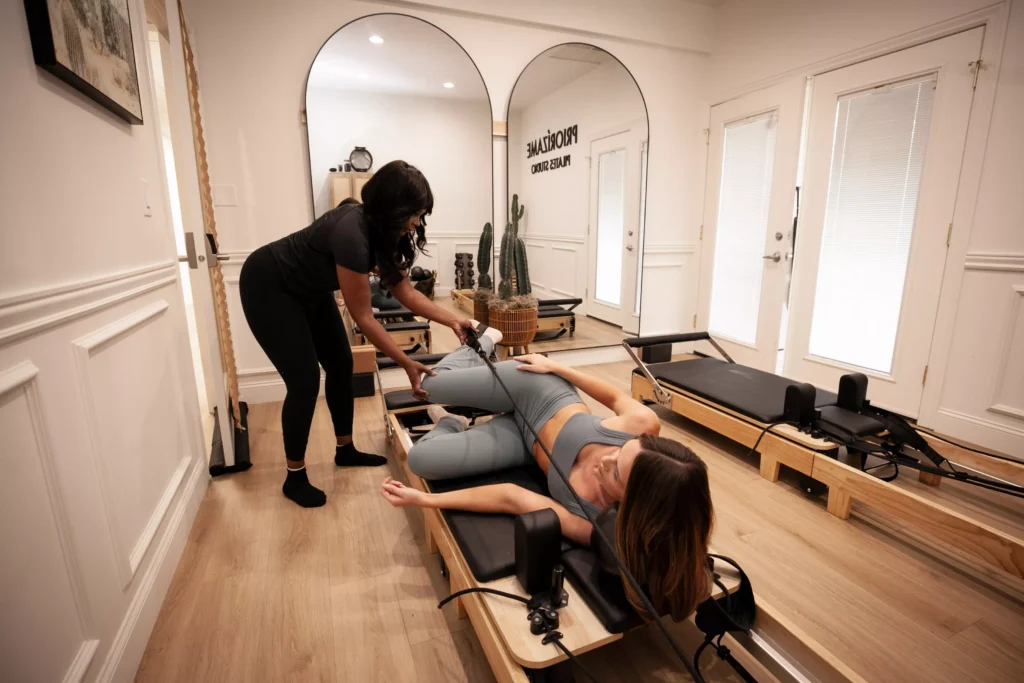
Through pregnancy, and afterwards, with someone teaching only you.
Not a modified version
of somebody else’s class.
Strong for it,
not just through it.
Staying strong while pregnant is not about pushing through. It is about keeping the strength you have, in the places that are about to be asked for a great deal: your back, your hips, your legs, and the pelvic floor that is quietly reorganising itself around a growing baby.
What is appropriate shifts as you go. Positions that were fine at twelve weeks are not at thirty. Certain movements come out entirely. Your session changes with you, week by week, because the same instructor is teaching and adjusting it.
Rebuilding,
not bouncing back.
You were discharged with a baby and almost nothing about your own body. Most women are told to wait six weeks and then given no idea what to do at week seven.
Here is what we do. We start further back than you expect, with breathing and the pelvic floor, because everything else is built on it. We work on the pelvic floor without embarrassment and without treating it as a mystery. We watch how your midline is knitting back together and we do not load it before it is ready.
Then, slowly, we add strength back. You will gain confidence.
To get your strength back, which is the thing that actually makes carrying a toddler and a car seat survivable.
Four things
we get right.
We wait for your provider
We ask about the whole picture
We use the springs to take load off
We go at the speed your body sets
Not the speed of a twelve-week program. Some weeks you will progress. Some weeks you slept for three hours and we do the version that suits that.
The ones people
ask quietly.
When in pregnancy can I start?
Any trimester, as long as your provider is happy. If you are new to Pilates, the first trimester is the easiest time to learn the basics, but plenty of women start later and do well.
I have never done Pilates and I am already pregnant. Is it too late?
No. We teach you a smaller set of things and teach them properly, rather than trying to cover everything. That is an advantage of working one-on-one.
What is diastasis, and will you check for it?
It is the separation of the abdominal muscles that happens in most pregnancies, and it usually closes on its own to some degree. We will look at how your midline is managing load and choose exercises accordingly. Assessing and treating it clinically is a job for a pelvic health physio, and we are glad to work alongside one.
Can I bring the baby?
Should I be doing this if I am leaking when I sneeze or run?
It is very common and it is not something you have to accept. Strength work helps, and we will train with it in mind. If it is persistent, see a pelvic health physio as well. The two things work together.
Privates, or can I do a class?
Privates, at least to begin with. A group class cannot adjust to what trimester you are in or what your provider has restricted. Once you are further along in recovery, classes become a good option again.
This page is general education, not medical advice, and nothing on it replaces your doctor, midwife or physio. Talk to your provider before starting or returning to exercise during pregnancy or after birth, and tell us what they said. We will work within it.